
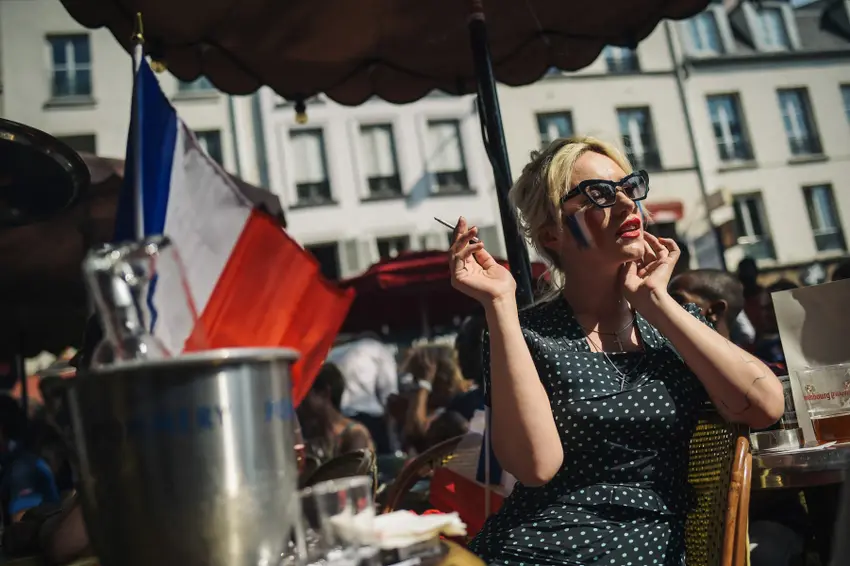
France might have an international reputation as the 'chimney of Europe' but it has in fact had a ban on smoking in indoor public spaces since 2007.
In truth, France isn't quite as smoky as its image suggests - although it does still have a higher proportion of regular smokers than the EU average. Much of the image of the French as a nation of cigarette lovers comes from the films of the French New Wave and pop culture icons like Serge Gainsbourg, who was rarely pictured without a cigarette in hand.
MAP Where in France do people smoke the most
In the years since the 2007 smoking ban the French government has enacted a series of measures aimed at persuading people to quit including steep hikes on the taxes charges on tobacco.
However a new law has now extended the smoking ban to include some outdoor spaces.
Initially planned to be introduced from July 1st, the decree signing it into law took effect on Sunday, June 29th - the decree, published in the official government gazette on Saturday, also bans smoking outside libraries, swimming pools and schools, and is aimed at protecting children from passive smoking.
Here's what changes:
Indoor spaces
Smoking in indoor public spaces and workplaces has been illegal in France since 2007.
This covers offices, shops, other workplaces, leisure spaces such as cinemas and hospitality spaces such as the indoor areas of bars, cafés and restaurants. Public transport is also a no-smoking zone.
The ban also covers some private spaces - specifically it is illegal to smoke in a car if there are children under the age of 12 inside.
Private homes or other private spaces are exempt from the ban. This includes rented properties - it is very unusual for landlords to try and ban tenants from smoking (although check your contract to be sure). When it comes to tourist rentals, however, it's increasingly common to have a no-smoking policy.
Outdoor spaces
The new law extends the ban to include some outdoor areas as well.
Smoking is now banned in all spaces where children could be present, including "beaches, parks, public gardens, outside of schools, bus stops and sports venues", said the minister Catherine Vautrin.
New areas covered by the ban are;
- Parks and public gardens
- Beaches and outdoor swimming spaces
- Bus shelters and similar covered spaces for travellers
- Areas outside schools, nurseries and all other buildings that are designed to welcome children
- Open spaces surrounding libraries, swimming pools, sports centres and stadiums
- Ski resorts - smoking is not allowed on the pistes, in ski lifts or in the queue for the ski lift
In truth, many local authorities have already enacted bans on smoking in some or all of the above spaces under the power given to them by local bylaws, but this is now standardised across the country.
What about café terraces?
Café terraces occupy an in-between status when it comes to the indoor or outdoor areas - but they are excluded from the new outdoor smoking ban, despite them being a place where children could be.
The terrace has been something of a smoking battleground ever since the 2007 smoking ban came in, especially in winter. In response to the ban in 2007 many café owners created sheltered or covered 'terrace' spaces so that their customers could continue to smoke without having to go outside in the winter.
Although these spaces remain technically a terrace, in winter you will often see places with three walls and a roof that look remarkably like an indoor space to the uninitiated. Technically, these remain legal so long as the walls are temporary and can be removed once the good weather arrives.
Café owners have vigorously resisted any expansion of anti-smoking laws, saying it will cripple their business, and it seems that the government has listened to them.
Therefore the smoking rules in bars, cafés and restaurants will remain the same as they are now - not allowed inside but allowed on the terrace, even if the terrace has walls and a roof.
There is no particular rule around smoking in areas where food is served - if you want to be sure of a smoke-free environment, you will need to go inside. If the windows are open and the smoke from smokers outside on the terrace drifts in, then unfortunately that's just bad luck.
On film
One thing that often surprises visitors from the US is seeing characters in French films and TV series lighting up. There is no restriction in France on characters smoking on film, and no plans to change this.
Enforcement
The new outdoor smoking ban carries the same penalty as the indoor ban - a €135 fine for lighting up in a prohibited area - but any law is only as good as its enforcement.
At present the law around indoor smoking is fairly well established and, on the whole, quite well enforced.
The bits that are less well enforced are those areas that could be seen as a grey area - for example, smoking in public transport hubs is not permitted, but it's very common to see people lighting up on the platform in train stations, as these could be argued to be an outdoor space.
Likewise although it would be unusual to see someone lighting up in a fully indoor area such as a swimming pool, it's common and broadly tolerated for people to smoke in sports stadiums which are open to the air.
Enforcement of local bylaws banning smoking in areas such as beaches has so far depended on the area and whether the local authority has the resources to police such a ban.
Local laws
Local authorities maintain their powers to expand a smoking ban to public spaces not mentioned in the new law if they wish to.
In the summer smoking is often banned in national forests, because of the risk of wildfires - keep an eye out for signs announcing a smoking ban in a certain area.
What about vaping?
Somewhat confusingly, vapes or electronic cigarettes are partially covered by the old law but are not covered in the new outdoor ban.
It will therefore remain legal to vape outdoors in places such as beaches or outside schools, even after the introduction of the new law.
When it comes to indoor use, vapes have a 'half and half' status - it is prohibited on enclosed forms of public transportation, and in enclosed workspaces intended for collective use.
Restaurants, cafés, shopping centres and nightclubs can legally allow vaping, although the owners can also introduce private rules prohibiting vaping.
In general the rules are not well enforced, in part because of confusion around what the law actually says. In 2023 the then-prime minister Elisabeth Borne sparked a controversy over her habit of vaping in the French parliament (her workplace).
Comments