
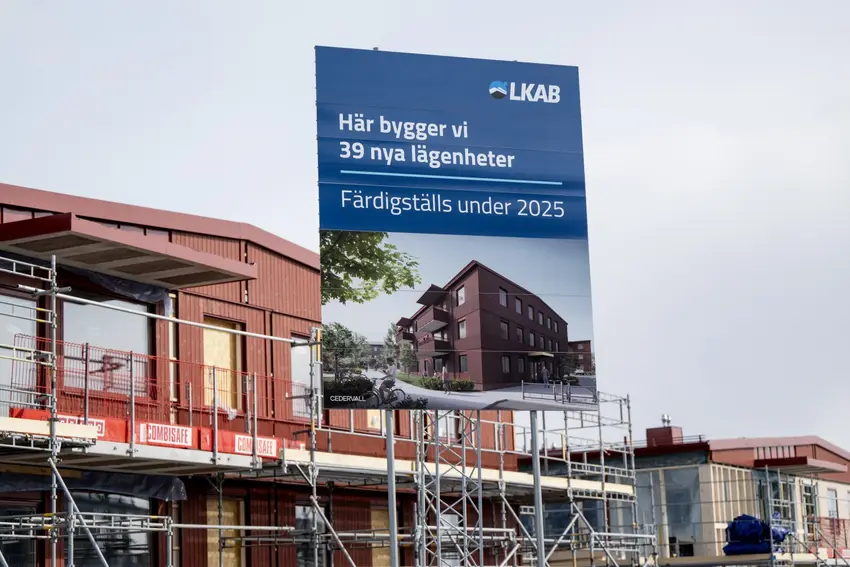
The report, from Public Housing Sweden, an interest organisation for public housing companies, says there are “two sides” to the housing situation in Sweden.
Some parts of the country have “an acute lack of housing”, it says, while others have a growing number of empty apartments.
In fact, the number of empty apartments among the 200 housing companies who filled in Public Housing Sweden’s questionnaire has almost doubled in the last year, with more than half of the companies saying that they had rentable apartments which had been empty for more than three months.
Sweden has two types of rentals when it comes to apartments, first-hand and second-hand rentals. In a first-hand rental, you're renting directly from the landlord. That could be a municipality or a rental agency, but these properties are subject to state-regulated rent controls, which are intended to keep prices reasonable.
The catch is that these are generally allocated via a queue system: you sign up, in some cities pay a nominal fee each year and earn credits the longer you queue, which give you higher priority when a property becomes available. Queue times vary between municipalities, and it's common to wait years ‒ or even decades in larger cities ‒ until it's your turn.
A second-hand rental is a sublet, where you're renting from a private individual who is either renting their apartment from the landlord or who owns an apartment in a housing association.
Around a third of the housing companies in the report said that potential renters can find a first-hand rental within a year, with those companies primarily in smaller towns and in the countryside, although some larger towns were also included.
When specifically asked about new-build apartments, that figure rose to half, with the majority of those in small and medium-sized towns.
The report defines smaller towns and the countryside as municipalities where the largest town has fewer than 40,000 inhabitants, while larger towns have more than 40,000 and fewer than 200,000 inhabitants.
Cities, defined as towns with more than 200,000 inhabitants, essentially refer to Stockholm, Malmö and Gothenburg. Adjacent municipalities where more than 40 percent of the population commute to a larger town were also included in this figure.
Queues were, perhaps unsurprisingly, longer in Sweden’s three largest cities.
Only one of seven companies could offer a queue time of under a year for a new-build in one of Sweden's largest cities, with that number rising to 4 of 25 companies in municipalities close to the three largest cities. None of the companies in the three largest cities could offer queue times of less than a year for older apartments.
It doesn’t look like the situation is likely to improve in the short-term either as far as cities are concerned, the report reads.
“The need for new production is substantial, but high building costs make it essentially impossible to produce housing with reasonable rents.”
“This means that property construction risks remaining at low levels, which risks making the situation with low supply worse and extending the queues in areas where it’s already difficult to find somewhere to live,” it reads.
The report warns that this could lead to overcrowding and homelessness, as well as making the situation even more difficult for people who already struggle to find housing.
There were also 50 housing companies – a quarter of respondents to the questionnaire – where applicants could rent an apartment straight away.
On a regional level, the difference in queue length is striking. People looking to rent an apartment in Södermanland south of Stockholm had to wait an average of 15 months in the queue, while those looking in Stockholm had to wait a whopping 337 months, or 28 years.
Stockholm was the only region with a three-figure waiting time, with the next highest region, Skåne, waiting 79 months, or a much more reasonable six and a half years, which is perhaps not surprising considering it is home to Malmö, Sweden’s third largest city.
Halland came in third place with 63 months, just over five years, while Västra Götaland, the county where Sweden’s second-largest city Gothenburg is located, came in fourth place with 56 months, over four and a half years.
Aside from Södermanland, the regions with the shortest queues were Blekinge, Gävleborg (both 16 months) and Västerbotten (17 months).
See waiting times for all regions in the map below.
Comments